Timeline: Difference between revisions
Jump to navigation
Jump to search
Created page with "df" |
No edit summary |
||
| Line 1: | Line 1: | ||
=== 1880s === | |||
* '''1881:''' The [[Railroad Companies|Chesapeake and Ohio Railway (C&O)]] was extended from Richmond to Newport News to transport coal mined in West Virginia to reach the harbor of Hampton Roads. | |||
* '''1883:''' The first railcar loaded with bituminous coal arrived in Norfolk via the [[Railroad Companies|Norfolk & Western Railway]] (now [[Railroad Companies|Norfolk Southern]]). | |||
* '''1886:''' The train tracks were extended to the coal piers near [[Lambert's Point, Norfolk|Lambert's Point]]. | |||
=== 1920s === | |||
* '''1927:''' The Newport News ''Daily Press'' describes the use of sprinklers to "minimize damage and discomfort arising from large quantities of [[Particulate matter and coal dust|coal dust]] in the air."<ref>[[:File:Daily Press 1927 11 23 Page 2.pdf|Railroads of Port Adopt Coal Sprinkle: Growing Demand for Sprinkled Coal Said to Be Made by Trans-Shippers]], ''Daily Press'', November 23, 1927.</ref> | |||
=== 1950s === | |||
* '''1954:''' The Garden-Shores Civic League write a letter to the City of Newport News complaining about [[Particulate matter and coal dust|coal dust]] pollution believed to be "uncombusted coal blown from the railways' two coal dumping piers."<ref>[https://voicesinthedust.org/File:Daily_Press_1954_04_12_Page_3.pdf Newport News to Analyze Smoke and Soot Nuisance in Garden-Shores Sector], ''Daily Press'', April 4, 1954.</ref> | |||
* '''1956:''' The City of Newport News hires a chemical engineering firm to [[Local air monitoring|measure the amount of coal in airborne particles]], who find that at least in one location 45% of airborne dust was coal.<ref>[[:File:Daily Press 1956 12 04 Page 5.pdf|Council]], ''Daily Press'', December 4, 1956.</ref><ref name=":0">[[:File:Daily Press 1956 12 12 Page 3.pdf|C&O to Install Costly Equipment for Control of Air Pollution in NN]], ''Daily Press'', December 12, 1956.</ref> | |||
* '''1956:''' This air monitoring study prompts the [[Railroad Companies|Chesapeake and Ohio (C&O) Railroad Company]] to install equipment to create a [[Chemical dust suppression: water sprinklers and chemical sealants|water fog over the coal piers to suppress dust]]<ref name=":0" /> and led the [[Newport News City Council]] to pass an air pollution ordinance.<ref>[[:File:Daily Press 1956 12 18 Page 3.pdf|Council Gets Air Pollution Control Plan]], ''Daily Press'', December 18, 1956.</ref> | |||
=== 1970s === | |||
* Jessie Rattley, the first Black mayor of Newport News, and other local leaders have discussions around [[Particulate matter and coal dust|coal dust]] mitigation. | |||
* Linwood DeBrew and community members begin organizing around [[Particulate matter and coal dust|coal dust]] pollution issues. | |||
=== 1980s === | |||
* The City of Newport News overturns its air pollution ordinance. [[File:Daily Press January 27 1985.png|alt=Mrs. Bazemore shows coal dust she cleaned from the inside of her Ridley Circle home in Murry, Coal Dust Causes Concern, Daily Press, January 27, 1985.|thumb|''Daily Press'': A leading activist for coal dust mitigation in the 1980s, Mrs. Louise Bazemore is photographed displaying the coal dust she cleaned from inside her Ridley Circle home.<ref>Murry, [[:File:Daily Press 1985 01 27 Page 5.pdf|Coal Dust Causes Concern ]][https://voicesinthedust.org/File:Daily_Press_1985_01_27_Page_5.pdf (Continued from Page C1)], ''Daily Press'', January 27, 1985.</ref>]] | |||
* The first recorded [[Coal dust complaints|complaint]] from Lambert's Point, Norfolk. | |||
* Community activism in [[Southeast Newport News]] and [[Coal dust complaints|residents' complaints]] to [[Virginia Air Pollution Control Board|Virginia Air Pollution Control Board (APCB)]] led the [[Virginia Air Pollution Control Board|APCB]] to conduct additional research on the factors that influenced coal dust emissions and develop a wet suppression approach that was more effective. | |||
* '''1987:''' This research was published in the report: [[:File:Coal Study-January 1987 21391318.pdf|Control of Fugitive Emissions from Open Coal Storage in Newport News, Virginia]]. | |||
=== 1990s === | |||
* '''1990:''' The [[Virginia Department of Environmental Quality (VA DEQ)]] is formally established, with [[Particulate matter and coal dust|coal dust]] regulation becoming a priority issue. | |||
* [https://history.house.virginia.gov/members/8916 Representative Dick Cranwell] sponsors a bill requiring [[Companies: railroads, terminals, and coal|Norfolk Southern]] to report air quality and [[Particulate matter and coal dust|coal dust]] emissions. | |||
* The 1993 [https://law.justia.com/cases/federal/district-courts/FSupp/768/1144/2364908/ RISE, Inc. v. Kay] lawsuit challenges a landfill siting in King and Queen County citing [[Environmental justice|environmental racism]], further shaping the conversation around [[environmental justice]] in Virginia. | |||
=== 2000s === | |||
* The [[Southeast CARE Coalition|Southeast Community Action for a Renewed Environment (CARE) Coalition]], then led by Dr. Erica Holloman, Linwood DeBrew, and Angela Harris, intensifies organizing efforts around [[Particulate matter and coal dust|coal dust]] pollution and [[Environmental justice|environmental racism]] in Southeast Newport News. | |||
* In 2002, the [[Southeast CARE Coalition]] formally pushes for investigations into the health impacts of [[Particulate matter and coal dust|coal dust]], collaborating with the U.S. EPA. | |||
=== 2010s === | |||
* The [[Southeast CARE Coalition]] and U.S. EPA report is released: [[:File:A COLLABORATIVE EFFORT TO ASSESS ENVIRONMENTAL HEALTH IN NEWPORT NEWS VIRGINIA FINAL.PDF|A Collaborative Effort to Assess Environmental Health in Newport News, Virginia]] | |||
* Increased activism in Lambert's Point under the slogan Cover the Coal, led by New Virginia Majority and the Sierra Club Virginia Chapter, and supported by academic researchers like Dr. Anna Jeng from Old Dominion University, highlights the need for stronger air quality monitoring and regulatory measures. | |||
* Planning grants are secured to explore coal dust solutions; coal dust-related petitions are circulated. | |||
=== 2020s === | |||
* In 2020, the [https://law.lis.virginia.gov/vacodefull/title2.2/chapter2/article12/ Virginia Environmental Justice Act] is passed, with the state government committing to integrate [[environmental justice]] principles into decision-making. | |||
* The [[Virginia Department of Environmental Quality (VA DEQ)|VA DEQ]] secures funding for the [[Tidewater Air Monitoring Evaluation (TAME)]] to track [[Particulate matter and coal dust|coal dust]] levels in Southeast Newport News and Lambert's Point in 2020, with data collection yet to start. | |||
* The [[Repair Lab]] [https://coaldustkills.wpcomstaging.com/ Coal Dust Kills] effort begins interviewing residents affected by [[Particulate matter and coal dust|coal dust]] pollution in Southeast Newport News and Lambert's Point, [[VOICES: Voices Organizing In opposition to Coal dust with Environmental Sensing Network|monitoring ambient dust concentrations]], and sampling dust inside residents home to identify evidence of [[Particulate matter and coal dust|coal dust]] exposure. | |||
* In 2024, Adrian Wood releases [https://coaldustkills.wpcomstaging.com/?p=6400 Crosswinds], a multi-episode podcast exploring the [[Particulate matter and coal dust|coal dust]] issues through the friendship of local activists, Lathaniel Kirts and Malcolm Jones. | |||
* The Repair Lab and [https://aahsnn.wildapricot.org/ African American History Society of Newport News] begin work on a digital archive documenting decades of [[Particulate matter and coal dust|coal dust]] activism and [[environmental justice]] efforts in Virginia. | |||
Revision as of 22:29, 24 December 2025
1880s
- 1881: The Chesapeake and Ohio Railway (C&O) was extended from Richmond to Newport News to transport coal mined in West Virginia to reach the harbor of Hampton Roads.
- 1883: The first railcar loaded with bituminous coal arrived in Norfolk via the Norfolk & Western Railway (now Norfolk Southern).
- 1886: The train tracks were extended to the coal piers near Lambert's Point.
1920s
- 1927: The Newport News Daily Press describes the use of sprinklers to "minimize damage and discomfort arising from large quantities of coal dust in the air."[1]
1950s
- 1954: The Garden-Shores Civic League write a letter to the City of Newport News complaining about coal dust pollution believed to be "uncombusted coal blown from the railways' two coal dumping piers."[2]
- 1956: The City of Newport News hires a chemical engineering firm to measure the amount of coal in airborne particles, who find that at least in one location 45% of airborne dust was coal.[3][4]
- 1956: This air monitoring study prompts the Chesapeake and Ohio (C&O) Railroad Company to install equipment to create a water fog over the coal piers to suppress dust[4] and led the Newport News City Council to pass an air pollution ordinance.[5]
1970s
- Jessie Rattley, the first Black mayor of Newport News, and other local leaders have discussions around coal dust mitigation.
- Linwood DeBrew and community members begin organizing around coal dust pollution issues.
1980s
- The City of Newport News overturns its air pollution ordinance.
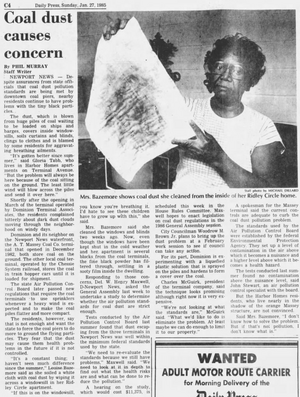
Daily Press: A leading activist for coal dust mitigation in the 1980s, Mrs. Louise Bazemore is photographed displaying the coal dust she cleaned from inside her Ridley Circle home.[6] - The first recorded complaint from Lambert's Point, Norfolk.
- Community activism in Southeast Newport News and residents' complaints to Virginia Air Pollution Control Board (APCB) led the APCB to conduct additional research on the factors that influenced coal dust emissions and develop a wet suppression approach that was more effective.
- 1987: This research was published in the report: Control of Fugitive Emissions from Open Coal Storage in Newport News, Virginia.

1990s
- 1990: The Virginia Department of Environmental Quality (VA DEQ) is formally established, with coal dust regulation becoming a priority issue.
- Representative Dick Cranwell sponsors a bill requiring Norfolk Southern to report air quality and coal dust emissions.
- The 1993 RISE, Inc. v. Kay lawsuit challenges a landfill siting in King and Queen County citing environmental racism, further shaping the conversation around environmental justice in Virginia.
2000s
- The Southeast Community Action for a Renewed Environment (CARE) Coalition, then led by Dr. Erica Holloman, Linwood DeBrew, and Angela Harris, intensifies organizing efforts around coal dust pollution and environmental racism in Southeast Newport News.
- In 2002, the Southeast CARE Coalition formally pushes for investigations into the health impacts of coal dust, collaborating with the U.S. EPA.
2010s
- The Southeast CARE Coalition and U.S. EPA report is released: A Collaborative Effort to Assess Environmental Health in Newport News, Virginia
- Increased activism in Lambert's Point under the slogan Cover the Coal, led by New Virginia Majority and the Sierra Club Virginia Chapter, and supported by academic researchers like Dr. Anna Jeng from Old Dominion University, highlights the need for stronger air quality monitoring and regulatory measures.
- Planning grants are secured to explore coal dust solutions; coal dust-related petitions are circulated.
2020s
- In 2020, the Virginia Environmental Justice Act is passed, with the state government committing to integrate environmental justice principles into decision-making.
- The VA DEQ secures funding for the Tidewater Air Monitoring Evaluation (TAME) to track coal dust levels in Southeast Newport News and Lambert's Point in 2020, with data collection yet to start.
- The Repair Lab Coal Dust Kills effort begins interviewing residents affected by coal dust pollution in Southeast Newport News and Lambert's Point, monitoring ambient dust concentrations, and sampling dust inside residents home to identify evidence of coal dust exposure.
- In 2024, Adrian Wood releases Crosswinds, a multi-episode podcast exploring the coal dust issues through the friendship of local activists, Lathaniel Kirts and Malcolm Jones.
- The Repair Lab and African American History Society of Newport News begin work on a digital archive documenting decades of coal dust activism and environmental justice efforts in Virginia.
- ↑ Railroads of Port Adopt Coal Sprinkle: Growing Demand for Sprinkled Coal Said to Be Made by Trans-Shippers, Daily Press, November 23, 1927.
- ↑ Newport News to Analyze Smoke and Soot Nuisance in Garden-Shores Sector, Daily Press, April 4, 1954.
- ↑ Council, Daily Press, December 4, 1956.
- ↑ 4.0 4.1 C&O to Install Costly Equipment for Control of Air Pollution in NN, Daily Press, December 12, 1956.
- ↑ Council Gets Air Pollution Control Plan, Daily Press, December 18, 1956.
- ↑ Murry, Coal Dust Causes Concern (Continued from Page C1), Daily Press, January 27, 1985.