Main Page
Coal dust pollution in Virginia is an open secret—its black residue is visible to residents but strategically ignored by politicians, regulators, and polluters. Massive coal storage dunes loom and coal-filled train cars screech along the tracks night and day, as winds carry toxic coal particles through the air and into homes. In Virginia, which exports more coal than any other U.S. state, Black neighborhoods in Newport News and Norfolk are the most harmed. While coal dust pollution can be seen with the unaided eye—if seeing is believing, why has the response been so uneven and insufficient?
The answer is not simply a lack of evidence. It is that certain forms of knowledge—resident testimonies, grassroots monitoring, experiential data—are not recognized as authoritative in the systems and institutions that hold power and decision-makers, at every level of government, have failed to pursue and implement the real solutions and adequate protections their constituents deserve and have asked for.
Communities with environmental justice concerns are typically among the least represented in policymaking and regulatory processes, while also facing barriers to the necessary information to identify their legal and policy options for change. This creates a persistent cycle that disadvantages affected communities, wherein residents must struggle to engage with a complex and scattered landscape of regulations, evidence, and tools. The lack of centralized information means activists must continually invest labor and time into the reproduction of research and strategies, often duplicating efforts without advancing their priorities. Community memory can fade over time as leaders age and neighborhoods gentrify, diminishing momentum and continuity of efforts. When communities cannot build on past knowledge and experiences, the likelihood of achieving meaningful outcomes declines.
A community archive opens a pathway from lived experience to political recognition—from private harm to public accountability.
Welcome to Voices in the Dust
Voices in the Dust is a living, digital archive for action—supporting activists in the fight against coal dust pollution and for environmental justice in Virginia. Combining public records, lived experience, and scientific data, Voices in the Dust is more than a record, it is a technology of political possibility. This is a place where fragments cohere into and under pressure, and where individual participation becomes collective power.
The goal is simple: give communities, researchers, journalists, and decision-makers access to the historical records, research, and community knowledge needed for understanding, accountability, and change.
We welcome you to explore, learn, and join the community working of people working to end coal dust pollution and repair its decades of damage in Newport News and Norfolk and beyond.
Voices in the Dust is a work in progress.
History and Place
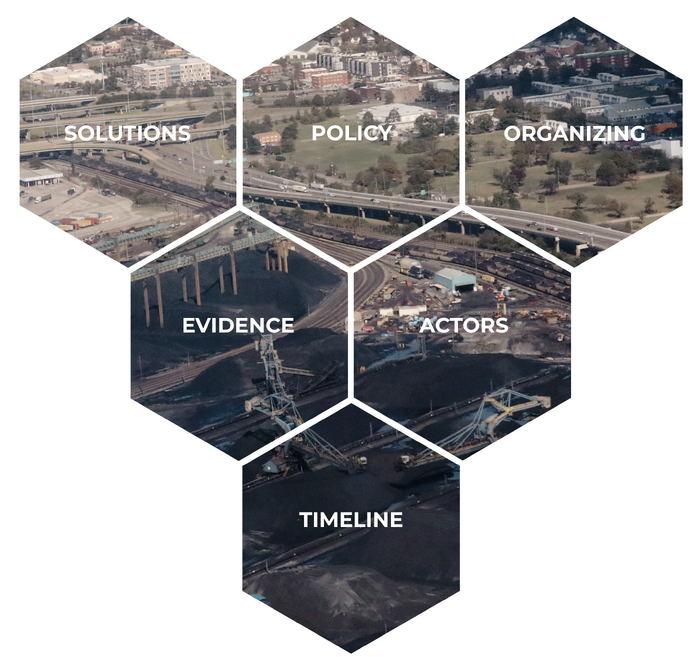
Explore by Theme: Start by learning and contributing to records of local history in Southeast Newport News and Lambert's Point, Norfolk. Understand the fundamentals of coal, airborne particles, coal dust, and environmental justice. Trace the institutionalization of environmental justice in Virginia and meet residents and early activists who won ground in the fight against coal dust pollution in the 1980s. Visit the Timeline to see an overview of events and actions that have shaped the coal dust issue in Newport News and Norfolk, Virginia.
BackgroundHistory
Place |
Evidence
Dive into the Evidence: The evidence that coal dust pollution harms residents of Southeast Newport News and Lambert's Point is overwhelming. This evidence exists in many forms, and these forms of evidence are valued differently by different audiences. Listen to residents and amplify their voices. Compare and understand the evidence that validates but also contradicts residents' testimonies, often produced by regulators and scientists, to challenge the systems and institutions that hold power and maintain the status quo.
Inspection ReportsResearch
Testimonials |
Actors
Who Are the Actors?: Meet the community organizations who have lead the fight against coal dust pollution and for environmental justice. Learn and build from their work to advance activism today and in the future. Understand the role of various government bodies and agencies, with an eye toward interacting effectively with these institutions and their members. Get to know the polluters too.
Community Organizations
Government Bodies
IndustriesRegulatory Agencies |
Solutions
There Are Solutions: Coal dust pollution is a solvable problem with commercially-available infrastructure solutions. What has worked and what has failed? Why does coal dust continue to plague residents when regulators and coal terminal executives claim dust mitigation technologies are in place? Familiarize yourself with various dust mitigation strategies to develop your own priorities and goals.
Infrastructure Solutions |
Policy
Navigate Policy to Change: Understand the three levels of government as relevant for addressing coal dust pollution. Learn about specific policies that may aid or directly apply to your work, for example, air and water permits, air quality standards, and your rights to access public records in Virginia. Can you use these policy levers to advance the fight against coal dust pollution?
Policy Levels
Relevant Policies |
Organizing
Engage and Organize: Grassroots activists and community organizations had led the fight for environmental justice, spurring the institutionalization of environmental justice in Virginia and scoring real wins. Community organizing is one of the most powerful tools available to bringing about change. Learn about and from current and past grassroots efforts to end coal dust pollution in Virginia, as well as in other locations that also struggle against coal dust pollution. Find opportunities to get involved and build collaborative networks.
Activism and Activities in Hampton Roads
Outside of Hampton Roads |
About Voices in the Dust and Getting Started
- About Voices in the Dust
- Getting Involved and Editing Voices in the Dust
- Style Guide
- Citing Voices in the Dust
- Creating Your Own Archive